

Mobile Website Design Services in NYC
Reach Above Media provides professional mobile website design services for small businesses, local companies, service providers, and growing brands in New York City. We build responsive websites that look great on smartphones, tablets, laptops, and desktop computers. A mobile-friendly website helps improve user experience, page speed, search visibility, and conversions. Whether you need a new website or want to upgrade an older site, our team can create a responsive design that supports your business goals.
Responsive Websites Built For Mobile Users
Designed For Growth & Performance
The use of mobile phones has become the main platform used by a majority of users across the U.S. as a communication medium (especially ages 15-50). According to the latest statistics there are more people who communicate through SMS than there are through email, and there are more people who own a mobile phone than credit cards or computers.
Naturally, this has led business owners to try and tap into this market. The main viable avenues which have gained a lot of popularity in the recent past are mobile applications (apps) and mobile-optimized websites. This has led to a debate in some circles, on which method is better, especially if you intend to use only one.
Since July 1st 2019, mobile-first indexing was enabled by default for all new websites (new to the web or previously unknown to Google Search). For older or existing websites ranking and indexing was switched to mobile-first indexing. Mobile-first indexing means Google predominantly uses the mobile version of the content for indexing and ranking. Historically, the index primarily used the desktop version of a page’s content when evaluating the relevance of a page to a user’s query. Since the majority of users now access Google Search with a mobile device, Googlebot primarily crawls and indexes pages with the smartphone agent going forward.
But it’s not only Google. The same goes for all the major search engines, including Bing, Yahoo, Alexa, Siri, Cortana, ask, etc. Any business that wants exposure needs to think first the mobile experience and secondary the desktop version.
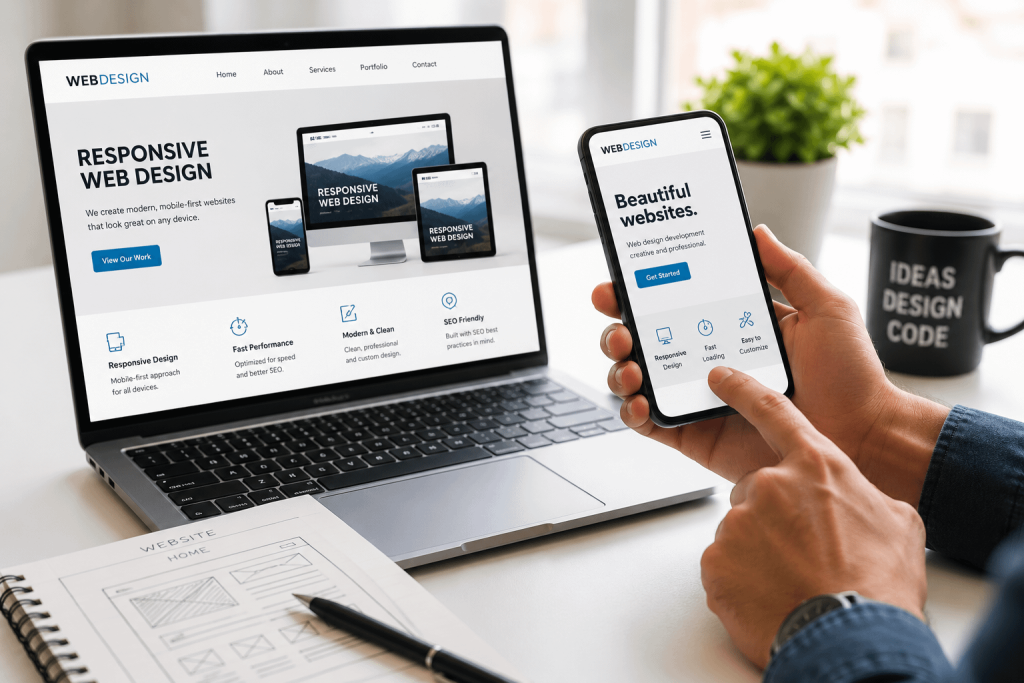

Responsive Design Built For Modern Devices
Every website we create is designed with mobile users in mind from the very beginning. Our approach ensures that content, navigation, and functionality remain consistent across smartphones, tablets, laptops, and desktop devices.
As technology and browsing habits continue to evolve, responsive design has become essential. We build websites that automatically adapt to different screen sizes and resolutions, creating a seamless experience regardless of the device being used.
A mobile-first strategy helps improve usability, increase engagement, and support stronger search visibility. The result is a clean, modern website that delivers a better experience for visitors while meeting today’s web performance standards.
Understanding Responsive Website Design
Responsive website design is a modern development approach that allows websites to automatically adjust to different screen sizes and devices. Whether visitors access a site from a smartphone, tablet, laptop, or desktop computer, the content remains easy to read, navigate, and interact with.
Rather than creating separate versions of a website for different devices, responsive design uses flexible layouts, scalable images, and adaptive styling techniques to deliver a consistent experience across all screen resolutions. This approach improves usability, enhances performance, and helps businesses meet the expectations of today’s mobile-first audience.
Key features of responsive web design include:
• Flexible layouts that scale proportionally across various screen sizes.
• Adaptive images and media that automatically resize to fit available viewing space.
• Device-specific styling that adjusts navigation, spacing, and content presentation.
• Improved user experience through consistent functionality across desktops, tablets, and smartphones.
• Better search engine performance, as modern search engines prioritize websites that provide strong mobile usability and responsive layouts.
As internet usage continues to shift toward mobile devices, responsive design has become an essential component of creating websites that are accessible, professional, and future-ready.


How Much Does A Mobile-Friendly Website Cost?
In most cases, building a mobile-friendly website does not significantly increase the overall project cost. Modern web development frameworks and responsive design technologies allow developers to create layouts that automatically adapt to different screen sizes without requiring separate websites for mobile and desktop users. This streamlined approach helps reduce development time while delivering a consistent experience across devices.
Responsive websites are designed to display content intelligently based on the visitor’s device. Elements such as navigation menus, images, sidebars, and page layouts can automatically adjust to improve usability and performance on smaller screens. By optimizing the experience for mobile visitors, businesses can improve loading speeds, enhance user engagement, and provide a cleaner browsing experience without sacrificing functionality on larger devices.
How We Help Your Business Succeed
Whether you’re launching a brand-new website or improving an existing one, we create mobile-first digital experiences tailored to your goals. Our team evaluates your audience, business objectives, and online requirements to develop a solution that delivers both visual impact and practical performance across all devices.
We focus on building responsive, user-friendly websites designed to attract visitors, strengthen engagement, and support long-term business growth. Every project is approached with a results-driven mindset to help maximize your online presence and overall success.

Mobile Website Design Services We Provide
Responsive Website Design
We design websites that automatically adjust and look good on phones, tablets, laptops, and desktops.
Mobile-Friendly Redesign
We improve older websites so they are easier to view, read, and use on mobile devices.
WordPress Mobile Design
We create mobile-friendly WordPress websites with clean layouts, fast pages, and easy navigation.
Joomla Mobile Design
We help build and improve Joomla websites so they work better across all screen sizes.
Mobile Landing Pages
We design mobile landing pages focused on calls, leads, form submissions, and better conversions.
Fast-Loading Mobile Layouts
We create lighter, faster mobile layouts to improve user experience and reduce page loading delays.
Mobile Navigation Optimization
We improve mobile menus, buttons, links, and page structure so visitors can find information quickly.
Mobile CTA Improvements
We improve calls-to-action, click-to-call buttons, forms, and contact options for mobile users.
Cross-Device Testing
We test your website on phones, tablets, and desktops to help make sure it works properly everywhere.
SEO-Friendly Mobile Structure
We build mobile pages with clean structure, readable content, and SEO-friendly layout for better search visibility.
Why Choose Reach Above Media for Mobile Website Design?
Reach Above Media has been helping businesses design, build, maintain, and improve websites since 2001. Our team understands responsive design, WordPress, Joomla, SEO, hosting, security, and website performance.
We focus on creating websites that are clean, mobile-friendly, fast, professional, and built around your business goals. From layout and navigation to forms and calls-to-action, every part of the website should help visitors take the next step.